Instant Cash Loans for Bad Credit: How AI Underwriting Normalizes Risk for Gig-Workers and Freelancers


Reviewed by
CFP® AuditFinancial Reviewer & Regulatory Compliance Auditor
Our content undergoes mathematical verification and regulatory scrutiny under TILA, FCRA, and state usury guidelines prior to release.
Editorial Policy & Integrity Pact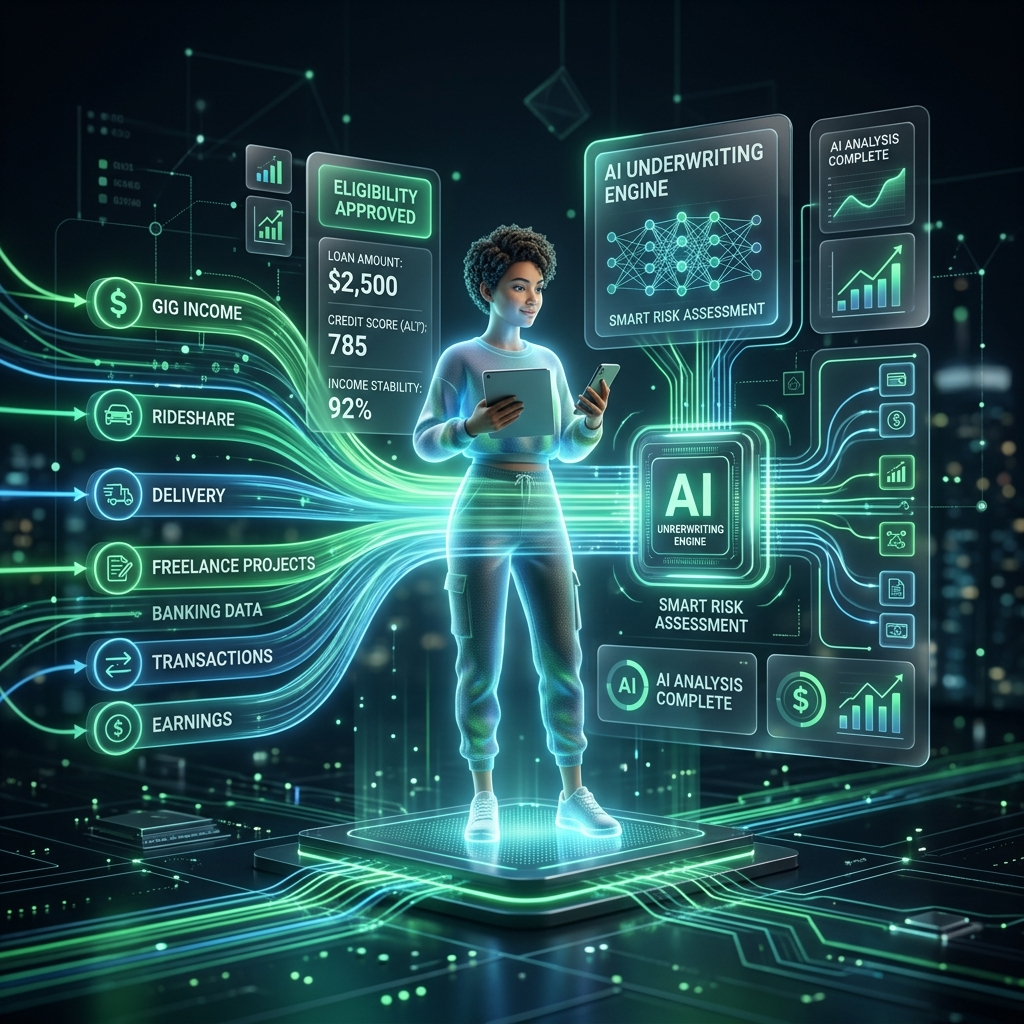
Direct Answer // TL;DR
TL;DR: The legacy banking system systemically discriminates against the 1099 workforce because rigid FICO models cannot process irregular, non-W2 income streams. Modern fintech platforms have solved this by deploying AI underwriting engines and Open Banking APIs. These algorithms bypass credit scores entirely, analyzing the raw telemetry of a gig worker’s cash flow—deposit frequency from platforms like Uber or Upwork, and real-time debt-to-income ratios—to instantly approve fair, amortized installment loans, even for individuals with severely damaged credit profiles.
The Structural Bias Against the 1099 Economy
The American workforce has undergone a massive structural transformation over the past decade. Millions of individuals have transitioned away from traditional, salaried W-2 employment, embracing the flexibility and autonomy of the “gig economy.” Whether driving for Uber, delivering for DoorDash, freelancing on Upwork, or operating independent creative studios, this 1099 workforce now constitutes a massive segment of the domestic GDP.
However, the legacy financial infrastructure—specifically the credit underwriting models utilized by traditional banks—refuses to acknowledge this reality. Traditional banking was built for the mid-20th-century worker. It expects a predictable, bi-weekly W-2 paycheck deposited in fixed increments. If an applicant cannot produce recent W-2s or employer verification forms, the bank’s automated systems simply freeze.
For the gig worker, income is inherently irregular. A driver might earn $1,200 during a holiday weekend and $400 the following week. A freelance developer might receive a massive $10,000 project payout, followed by a month of zero income while prospecting new clients.
When a gig worker with a damaged credit history (a subprime FICO score) approaches a traditional bank for an emergency loan, the rejection is instantaneous. The bank’s archaic models perceive irregular income as “unverifiable” and a low FICO score as “high risk,” resulting in a systemic denial of capital. This bias effectively exiles millions of hard-working individuals from the prime financial system, historically forcing them into the predatory arms of payday lenders.
The AI Disruption: Cash Flow Telemetry
The fintech industry recognized that the 1099 workforce was not inherently “high risk”; they simply required a different mathematical lens to evaluate their capacity to repay debt. The solution to the gig-worker dilemma arrived through the convergence of Artificial Intelligence (AI) and Open Banking API networks (such as Plaid, MX, and Finicity).
Modern digital lending platforms do not care about W-2s. They don’t even care about your FICO score. Instead, they utilize AI to perform “cash flow underwriting.”
When a gig worker applies for an instant loan, they connect their primary checking account to the lender via a secure API. Within milliseconds, the AI engine ingests up to 24 months of raw transaction data. The algorithm doesn’t look at a static score; it looks at the dynamic telemetry of the applicant’s financial life.
How the Algorithm Analyzes Gig Income:
- Platform Identification: The AI is trained to instantly recognize deposit signatures from major gig platforms (e.g., Stripe, Uber, Lyft, DoorDash, Fiverr). It understands that these deposits represent legitimate earned income, not random transfers.
- Velocity and Frequency: While the dollar amount of the deposits may fluctuate, the AI looks for the velocity of the income. If a driver receives 15 deposits from Uber over a 30-day period, the algorithm recognizes a high-frequency, reliable income stream, even if the individual amounts vary.
- Real-Time DTI Calculation: The algorithm concurrently analyzes the applicant’s outbound cash flow. It identifies recurring liabilities (rent, auto insurance, utilities) and calculates a real-time Debt-to-Income (DTI) ratio. If the gig worker’s aggregate income over a 90-day rolling average sufficiently covers their fixed liabilities with a margin for the new loan payment, the AI flags the profile as viable.
Explore Loan Options
*Estimates are for informational purposes only under Truth in Lending Act (TILA). APR ranges from 5.99% to 35.99% based on credit profile. Funding decisions are executed by partner algorithms. No impact on FICO score during evaluation.
Normalizing Subprime Risk Through Alternative Data
The power of AI cash flow underwriting is its ability to normalize subprime risk. In the legacy system, a FICO score of 580 is a red flag that stops the underwriting process entirely. In an AI-driven system, a 580 FICO score is merely one data point among thousands.
If the AI detects that the applicant’s credit score was severely damaged three years ago due to a medical bankruptcy, but their current Open Banking data shows consistent weekly income from freelance contracts and a healthy daily account balance, the algorithm overrides the historical FICO penalty. The AI correctly determines that the applicant’s current capacity to repay is strong, regardless of their past.
This is how modern platforms can offer instant cash loans for bad credit. By relying on empirical, real-time data, the lender can accurately price the risk. They don’t have to charge a 400% APR to offset blind uncertainty, because the uncertainty has been mathematically removed by the API analysis.
The Operational Mechanics of Instant Delivery
For gig workers, an emergency often directly impacts their ability to generate income. If an Uber driver’s transmission fails, or a freelance video editor’s laptop motherboard dies, they cannot afford a multi-day waiting period for a loan to clear. Every day without capital equates to lost revenue.
The architecture of modern fintech lending resolves this through integration with Real-Time Gross Settlement (RTGS) networks—specifically, The Clearing House’s RTP network and the Federal Reserve’s FedNow service.
Once the AI algorithm approves the loan based on cash flow telemetry, the lender’s backend system initiates an immediate push payment over these instant rails. The funds are transmitted and settled directly into the gig worker’s checking account in under 10 seconds, 24/7/365. An applicant can submit their data at 3:00 AM on a Sunday, receive algorithmic approval at 3:01 AM, and have the capital available in their account by 3:02 AM. This velocity is the definitive differentiator of modern subprime lending.
APR Interest Calculator
Simulate amortization schedules and evaluate the total cost of credit dynamically.
*This calculator is a simulation matching Truth in Lending Act (TILA) guidelines. Final rates depend entirely on matched participating lenders.
Strategic Borrowing for the 1099 Professional
While access to instant capital is a powerful tool, gig workers must utilize these loans strategically to avoid over-leveraging their volatile income streams.
- Prioritize Amortization: Never accept a lump-sum payday loan. Ensure the digital lender offers an amortized installment structure, breaking the repayment into fixed, predictable monthly payments. This is crucial for managing the natural ebb and flow of freelance income.
- Verify Bureau Reporting: Ensure the lender actively reports your positive monthly payments to the major credit bureaus (Equifax, Experian, TransUnion). This transforms the emergency loan into a credit-rehabilitation engine. By servicing the loan on time, you are actively repairing your damaged FICO score, preparing yourself to qualify for prime-rate borrowing in the future.
- Calculate the True Cost of Downtime: When evaluating an APR that feels high due to your subprime status, weigh the cost of the interest against the cost of your operational downtime. If a 30% APR loan costs you $300 in interest, but allows you to repair your vehicle instantly and generate $2,000 in gig income that week, the loan is a highly profitable strategic maneuver.
Conclusion: Financial Enfranchisement for the Modern Economy
The gig economy fundamentally changed how Americans work, but the financial system was painfully slow to adapt. For years, the 1099 workforce was economically disenfranchised, forced to rely on predatory lenders because traditional banks could not process their reality.
The deployment of AI underwriting and Open Banking APIs has finally corrected this structural flaw. By abandoning archaic FICO scores in favor of real-time cash flow telemetry, fintech platforms have successfully normalized the risk profile of the modern freelancer. Gig workers with bad credit no longer have to accept extortionate terms to survive an emergency. They can now leverage their actual, verifiable hustle to secure fair, algorithmic capital instantly, ensuring their micro-businesses remain operational regardless of the macroeconomic climate.
*Disclaimer: Instantloans.ai is an automated financial matching technology platform. We do not act as direct lenders. APRs vary by lender and state regulations, and are determined by the independent lender based on your credit profile. Rates are not guaranteed.
Liquidity Protocol Ready
Need Capital Now?
Bypass the friction. Match with tier-1 lenders instantly through our encrypted algorithmic routing engine.